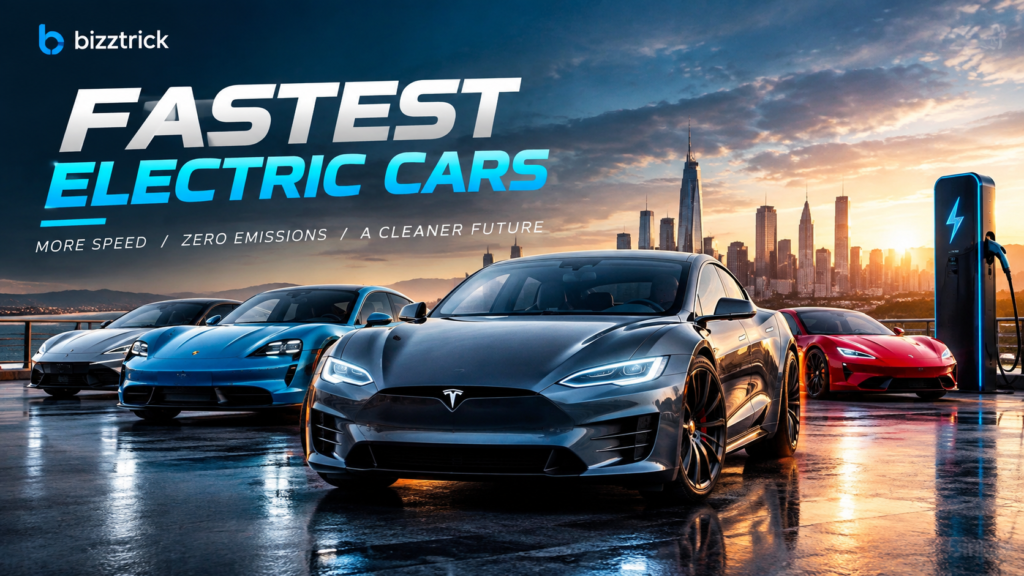

Electric cars are no longer associated only with efficiency, quiet driving, and long battery range. Modern performance EVs can accelerate faster than many traditional supercars while delivering instant torque and sophisticated all-wheel-drive systems.
In 2026, the fastest electric cars include everything from luxury performance sedans to limited-production hypercars. Some are designed to dominate the 0–60 mph sprint, while others are engineered to achieve extraordinary top speeds.
One of the biggest developments is the rise of the YANGWANG U9 Xtreme, which recorded 496.22 km/h (308.33 mph) at Germany’s ATP Papenburg test track in September 2025. BYD says the run made it the world’s fastest production car.
Let’s look at the electric vehicles pushing the boundaries of speed and performance.
What Makes an Electric Car Fast?
Before comparing the fastest EVs, it is important to understand what creates their performance.
Instant Electric Torque
Electric motors can deliver substantial torque almost immediately. Unlike conventional engines that need to build revs before producing peak performance, electric motors can respond extremely quickly.
Multiple Motors
High-performance EVs often use two, three, or four motors. Individual motors can control separate wheels, improving traction and allowing sophisticated torque-vectoring systems.
Battery Power Delivery
A performance EV needs a battery capable of delivering huge amounts of electrical power without excessive heat buildup. Advanced thermal-management systems are therefore critical for repeated acceleration runs.
Aerodynamics
At very high speeds, aerodynamic drag becomes one of the biggest challenges. Low-drag bodywork, active aerodynamic systems, and carefully designed cooling systems help high-performance EVs maintain stability and speed.
The Fastest Electric Cars in 2026
1. YANGWANG U9 Xtreme
Top speed: 496.22 km/h (308.33 mph)
The YANGWANG U9 Xtreme currently sits at the top of the electric-performance conversation. BYD reported that the car achieved 496.22 km/h at the ATP Papenburg test track in Germany on September 14, 2025.
That figure is extraordinary even by hypercar standards. BYD describes the U9 Xtreme as the world’s fastest production car following the record-breaking run.
The U9 platform uses BYD’s e⁴ technology and DiSus-X intelligent body-control system. The record-setting version also uses a 1200V electrical architecture and enhanced thermal-management technology.
For anyone searching for the fastest electric car by top speed, the U9 Xtreme is the name that deserves the most attention.
2. Rimac Nevera
0–60 mph: 1.74 seconds
0–100 km/h: 1.81 seconds
Top speed: 412 km/h (258 mph)
Power: 1,914 hp
The Rimac Nevera remains one of the most impressive electric hypercars ever produced.
According to Rimac, the Nevera uses four individually controlled electric motors and produces 1,914 hp. Its official specifications list a 0–60 mph time of just 1.74 seconds, while its top speed reaches 412 km/h (258 mph).
Its four-motor architecture allows the vehicle to distribute torque independently to each wheel. This is one reason the Nevera can combine extreme straight-line acceleration with sophisticated handling.
With production limited to 150 units, the Nevera is also exceptionally exclusive.
3. Lucid Air Sapphire
0–60 mph: 1.89 seconds
Top speed: 205 mph
Power: 1,234 hp
EPA-estimated range: 427 miles
The Lucid Air Sapphire proves that an electric performance car does not have to look like a traditional hypercar.
This luxury sedan combines three electric motors with 1,234 hp. Lucid lists a 1.89-second 0–60 mph time and a 205 mph top speed, while its EPA-estimated range is 427 miles.
That combination makes the Sapphire particularly interesting. It is not simply about acceleration; it attempts to combine supercar-level performance with the practicality of a premium four-door sedan.
4. Porsche Taycan Turbo GT with Weissach Package
0–60 mph: 2.1 seconds
Top speed: 190 mph
Power: up to 1,019 hp
The Porsche Taycan Turbo GT with the Weissach package demonstrates how far electric performance has progressed in a mainstream luxury performance brand.
Porsche lists a 2.1-second 0–60 mph time, up to 1,019 hp, and a 190 mph top speed for the Weissach-equipped version.
The Taycan is especially notable because it combines extreme acceleration with Porsche’s focus on braking, chassis tuning, cornering, and repeatable performance.
It is therefore an excellent example of a fast EV that is designed for more than straight-line acceleration.
5. Tesla Model S Plaid
0–60 mph: 1.99 seconds
Top speed: 200 mph with the required hardware upgrade
Power: 1,020 hp
The Tesla Model S Plaid helped redefine expectations for electric sedans.
Tesla currently lists the Plaid at 1.99 seconds from 0–60 mph, 1,020 hp, and a 200 mph top speed. Tesla notes that reaching the 200 mph figure requires a paid hardware upgrade; without it, the stated top speed is 163 mph.
Unlike many limited-production hypercars, the Model S Plaid combines exceptional acceleration with four-door practicality and substantial luggage capacity.
That makes it one of the most recognizable examples of a high-performance electric sedan.
6. Lotus Evija
Top speed: 218 mph
0–62 mph: under 3 seconds
Target power: 2,000 PS
The Lotus Evija takes a different approach to electric performance.
Lotus designed the Evija as an ultra-limited electric hypercar with a target output of approximately 2,000 PS and an electronically limited top speed of 218 mph. Lotus states that its 0–62 mph acceleration is under three seconds.
Its lightweight carbon-fiber construction and extensive aerodynamic development demonstrate that EV performance is not solely about adding more battery power.
Weight reduction, cooling, aerodynamics, and chassis engineering all matter.
7. YANGWANG U9
0–100 km/h: 2.36 seconds
Top speed: 309.19 km/h
Before the record-setting U9 Xtreme, the standard YANGWANG U9 had already established itself as a serious electric supercar.
BYD reports a 2.36-second 0–100 km/h time and a top speed of 309.19 km/h for the U9. The company also highlights its e⁴ platform and DiSus-X intelligent body-control system.
The U9 is particularly interesting because it demonstrates how quickly Chinese EV manufacturers have entered the high-performance electric-car market.
8. ZEEKR 001 FR
0–100 km/h: 2.02 seconds
Peak power: 930 kW / approximately 1,300 PS
The ZEEKR 001 FR brings hypercar-style acceleration to a more practical shooting-brake body.
ZEEKR lists a 0–100 km/h time of 2.02 seconds and 930 kW of peak power. The car uses four silicon-carbide electric motors and an enhanced 800V electrical system.
Its combination of performance and usable passenger space makes it one of the more unusual entries in the high-performance EV segment.
Fastest Electric Cars: Quick Comparison
| Electric Car | Acceleration | Top Speed |
|---|---|---|
| YANGWANG U9 Xtreme | Record-focused | 496.22 km/h / 308.33 mph |
| Rimac Nevera | 0–60 mph in 1.74 sec | 412 km/h / 258 mph |
| Lucid Air Sapphire | 0–60 mph in 1.89 sec | 205 mph |
| Tesla Model S Plaid | 0–60 mph in 1.99 sec | 200 mph* |
| Porsche Taycan Turbo GT Weissach | 0–60 mph in 2.1 sec | 190 mph |
| Lotus Evija | 0–62 mph under 3 sec | 218 mph |
| YANGWANG U9 | 0–100 km/h in 2.36 sec | 309.19 km/h |
| ZEEKR 001 FR | 0–100 km/h in 2.02 sec | 280 km/h |
*Tesla says the Model S Plaid’s 200 mph top speed requires the applicable paid hardware upgrade.
Performance figures can vary depending on testing conditions, tires, rollout methodology, battery state, temperature, and whether the manufacturer or an independent tester supplied the number.
Which Is the Fastest Electric Car?
The answer depends on how you define “fastest.”
If top speed is the deciding factor, the YANGWANG U9 Xtreme currently stands out after its reported 496.22 km/h production-car record.
If you’re looking at 0–60 mph acceleration, the Rimac Nevera’s official 1.74-second figure is extraordinary, while the Lucid Air Sapphire and Tesla Model S Plaid are also capable of sub-two-second launches under their respective testing conditions.
For everyday usability, however, the fastest car is not necessarily the best car. Range, charging speed, ride comfort, availability, service support, price, and practicality can be just as important.
What Should You Look for in a Fast Electric Car?
If you are considering a performance EV, don’t focus exclusively on the 0–60 mph number.
Consider:
- Battery capacity and thermal management
- Charging speed
- Real-world driving range
- Top speed
- Repeated acceleration performance
- Braking capability
- Tire and suspension setup
- All-wheel-drive system
- Availability in your country
- Maintenance and service support
- Overall price
A car that can accelerate incredibly quickly once may not deliver the same performance repeatedly if its battery or motors become too hot.
The Future of Fast Electric Cars
Electric performance technology is advancing rapidly. Higher-voltage electrical architectures, more powerful motors, improved batteries, advanced cooling systems, lightweight materials, and better software are allowing manufacturers to extract increasingly impressive performance from EV platforms.
The development of cars such as the YANGWANG U9 Xtreme also shows that the traditional definition of a supercar is changing. Electric vehicles can now challenge or exceed the top-speed figures associated with the world’s most expensive combustion-powered hypercars.
At the same time, manufacturers are working to make high performance more usable. Cars such as the Lucid Air Sapphire, Porsche Taycan Turbo GT, and Tesla Model S Plaid demonstrate that exceptional acceleration can exist alongside four-door practicality.
Frequently Asked Questions
What is the fastest electric car in 2026?
The YANGWANG U9 Xtreme is currently associated with the highest reported production-EV top-speed record, reaching 496.22 km/h (308.33 mph) at the ATP Papenburg test track in September 2025.
What is the fastest EV from 0 to 60 mph?
The Rimac Nevera officially lists a 0–60 mph time of 1.74 seconds, using a one-foot rollout measurement.
Is the Tesla Model S Plaid still one of the fastest electric cars?
Yes. Tesla lists the Model S Plaid at 1.99 seconds from 0–60 mph and up to 200 mph with the required hardware upgrade.
Which fast EV has the best range?
Performance and range involve trade-offs, but the Lucid Air Sapphire is notable because Lucid lists both 1,234 hp and an EPA-estimated 427-mile range.
Are electric cars faster than gasoline supercars?
In acceleration, several high-performance EVs can outperform many gasoline-powered supercars because electric motors provide immediate torque and sophisticated traction control. Top-speed performance is more complicated and depends heavily on aerodynamics, gearing, power delivery, tires, and thermal management.
Conclusion
The era of the slow, efficiency-focused EV is long gone. Today’s fastest electric cars include machines capable of sub-two-second acceleration and top speeds approaching or exceeding 300 mph.
The YANGWANG U9 Xtreme currently represents the extreme end of electric top-speed performance, while the Rimac Nevera, Lucid Air Sapphire, Tesla Model S Plaid, Porsche Taycan Turbo GT, Lotus Evija, and ZEEKR 001 FR demonstrate different approaches to electric speed.
The most exciting part is that this technology is still developing. As batteries, motors, software, aerodynamics, and charging systems improve, the performance gap between electric and traditional supercars will continue to become more interesting.