
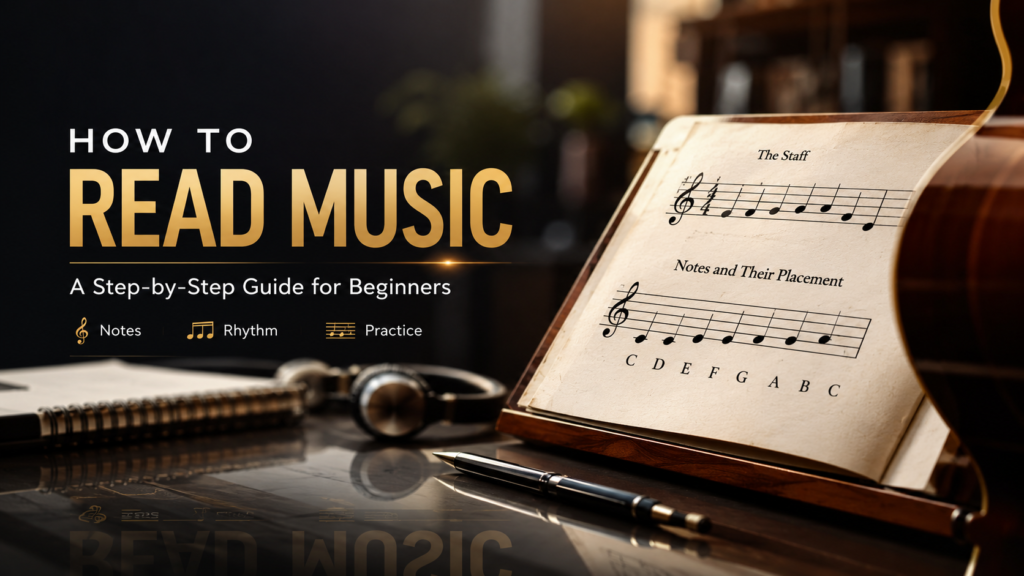

Learning how to read music may seem difficult at first, but it’s much easier when you understand the basic building blocks. Just like learning a new language, music has its own alphabet, grammar, and symbols. Once you know how they work together, reading sheet music becomes natural.
Whether you want to play the piano, guitar, violin, flute, or simply understand the music you love, learning to read music will make you a more confident musician.
In this guide, we’ll explain everything in simple English, making it perfect for complete beginners.
What Does It Mean to Read Music?
Reading music means understanding the symbols written on a sheet of music and translating them into sound. These symbols tell musicians:
- Which note to play
- How long to hold the note
- How loud or soft to play
- How fast the music should go
- When to pause
Think of sheet music as a map that guides performers through a song.
Why Learning to Read Music Is Worth It
Many successful musicians play by ear, but learning to read music offers major advantages.
Benefits include:
- Learn songs much faster
- Understand music theory
- Communicate with other musicians
- Improve timing and rhythm
- Memorize music more easily
- Play a wider variety of music
Whether you’re learning for fun or professionally, music reading opens many opportunities.
Understanding the Musical Staff
The first thing you’ll notice on sheet music is the staff.
A musical staff consists of five horizontal lines and four spaces.
Each line and space represents a different musical note.
-------------
-------------
-------------
-------------
-------------
Notes are placed on these lines and spaces to indicate pitch.
Meet the Musical Alphabet
Unlike the regular alphabet, music uses only seven letters:
A – B – C – D – E – F – G
After G, the sequence repeats.
Example:
A → B → C → D → E → F → G → A → B…
This repeating pattern forms the foundation of all Western music.
Understanding Clefs
A clef tells you which notes belong on each line and space.
The two most common clefs are:
Treble Clef
Used for:
- Piano (right hand)
- Guitar
- Violin
- Flute
- Trumpet
- Vocals
Treble Clef Lines:
E G B D F
Easy way to remember:
Every Good Boy Deserves Fun
Treble Clef Spaces:
F A C E
Simply remember:
FACE
Bass Clef
Used for:
- Piano (left hand)
- Bass guitar
- Cello
- Trombone
- Tuba
Bass Clef Lines:
G B D F A
Mnemonic:
Good Boys Do Fine Always
Bass Clef Spaces:
A C E G
Mnemonic:
All Cows Eat Grass
Understanding Musical Notes
Each note has a different duration.
Whole Note
- Lasts 4 beats
- Open circle
Half Note
- Lasts 2 beats
- Open circle with stem
Quarter Note
- Lasts 1 beat
- Filled circle with stem
Eighth Note
- Half beat
- Connected with one flag
Sixteenth Note
- Quarter beat
- Connected with two flags
Learning these note values is essential for reading rhythm correctly.
Understanding Rhythm
Rhythm tells you when to play each note.
Imagine tapping your foot while listening to music.
That steady pulse is called the beat.
Notes divide the beat into different lengths.
For example:
1 2 3 4
♩ ♩ ♩ ♩
Each quarter note receives one beat.
Time Signatures Explained
A time signature appears at the beginning of every piece.
Example:
4/4
Top number:
How many beats are in each measure.
Bottom number:
Which note receives one beat.
Common time signatures:
- 4/4 (Most popular)
- 3/4 (Waltz)
- 2/4 (March)
- 6/8 (Compound rhythm)
What Are Measures?
Measures divide music into equal sections.
Vertical lines separate one measure from another.
This organization helps musicians stay together while performing.
Understanding Key Signatures
A key signature tells you which notes are naturally sharp or flat throughout the piece.
You’ll see it immediately after the clef.
Common symbols include:
- Sharp (#)
- Flat (♭)
Example:
One sharp usually indicates the key of G major.
Knowing the key makes reading much easier.
Accidentals
Sometimes a note changes only for one measure.
These temporary changes are called accidentals.
They include:
- Sharp (#)
- Flat (♭)
- Natural (♮)
These symbols override the key signature temporarily.
Dynamics: Playing with Expression
Music isn’t just about correct notes.
It’s also about emotion.
Dynamic markings tell musicians how loudly or softly to play.
Examples:
- pp = very soft
- p = soft
- mp = moderately soft
- mf = moderately loud
- f = loud
- ff = very loud
Following dynamics makes music more expressive.
Tempo Markings
Tempo tells you how fast to play.
Common tempo markings include:
- Largo – Very slow
- Adagio – Slow
- Andante – Walking pace
- Moderato – Moderate
- Allegro – Fast
- Presto – Very fast
Modern sheet music may also include BPM (beats per minute).
Reading Chords
Instead of one note, multiple notes can appear together.
These are called chords.
For example:
- C Major
- G Major
- D Minor
- F Major
Piano players often play all notes together, while guitarists use chord shapes.
Helpful Beginner Practice Tips
Learning music is a gradual process.
Try these tips:
- Practice 15–20 minutes daily.
- Learn one concept at a time.
- Read easy sheet music first.
- Count beats aloud.
- Use a metronome.
- Practice note recognition every day.
- Play slowly before increasing speed.
Consistency is far more important than long practice sessions.
Common Beginner Mistakes
Avoid these habits:
- Trying advanced songs too early
- Ignoring rhythm
- Memorizing instead of reading
- Skipping basic theory
- Playing too fast
- Practicing inconsistently
Building a strong foundation leads to faster improvement.
Best Tools to Learn Music Reading
Many free and paid resources can help you practice.
Popular options include:
- Music theory apps
- Flashcard apps for note recognition
- Interactive piano learning software
- Online music courses
- Printable beginner sheet music
Using multiple learning methods can speed up your progress.
Real-Life Example
Imagine you see this simple melody:
Treble Clef

C D E F
♩ ♩ ♩ ♩
You would:
- Identify the treble clef.
- Recognize each note.
- Count four quarter-note beats.
- Play each note evenly.
Once you can do this confidently, you can gradually move to more complex melodies.
Frequently Asked Questions
Is it hard to learn how to read music?
Not at all. Most beginners understand the basics within a few weeks with regular practice.
Can adults learn to read music?
Yes. Adults often learn just as successfully as children because they can understand music theory more quickly.
Do I need to read music to play an instrument?
No, but reading music makes learning songs, understanding theory, and playing with others much easier.
How long does it take to learn?
Most beginners can read simple sheet music after a few weeks of consistent daily practice. Becoming fluent typically takes several months.
Which instrument is easiest for learning music reading?
Piano is often recommended because it clearly shows the relationship between notes and the keyboard layout.
Conclusion
Learning how to read music is one of the most valuable skills any musician can develop. While it may seem overwhelming initially, every symbol on a sheet of music has a clear purpose. By understanding the staff, notes, rhythms, clefs, key signatures, and dynamics, you’ll gain the confidence to read and perform music across many instruments.
Remember that progress comes from consistent practice rather than speed. Start with simple exercises, practice regularly, and gradually challenge yourself with more complex pieces. Over time, reading music will become as natural as reading words on a page.
If you’re serious about improving your musical skills, begin practicing today—every note you learn brings you one step closer to playing your favorite songs with confidence.