
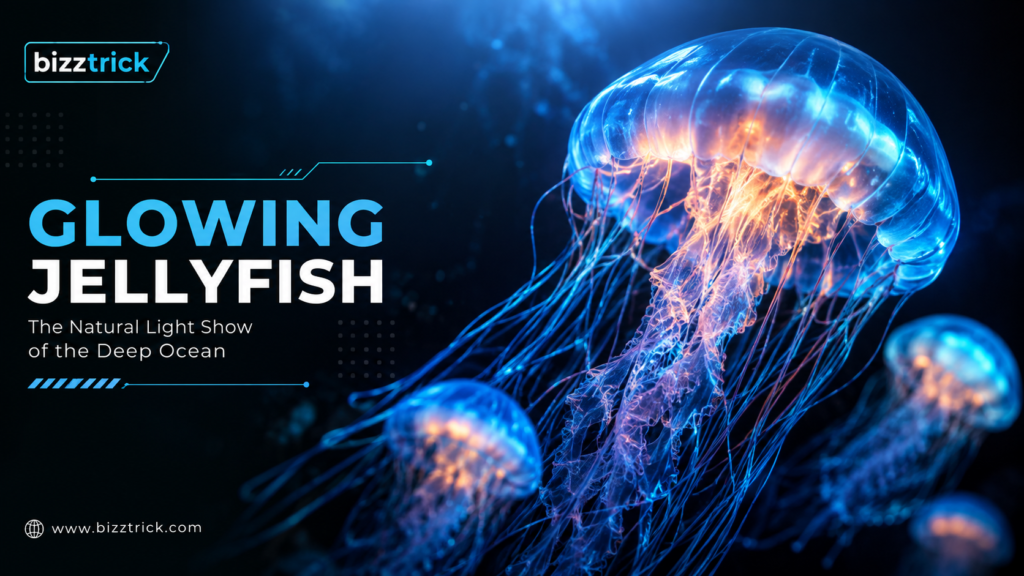

Imagine swimming through dark ocean water and suddenly seeing tiny blue-green lights moving around you. It may sound like something from a science-fiction movie, but this natural light show can be created by glowing jellyfish.
Jellyfish are among the most fascinating creatures in the ocean. Some species can produce or display light, creating an almost magical appearance in dark water. But why do they glow? Is every glowing jellyfish bioluminescent? And where can you find these remarkable animals?
In this guide, we’ll explore the science behind glowing jellyfish, their habitats, how they produce light, and some interesting facts that make them so unique.
What Are Glowing Jellyfish?
The term glowing jellyfish generally refers to jellyfish that produce, emit, or appear to emit light in the water. The phenomenon is usually associated with bioluminescence, a natural chemical process that allows certain marine organisms to create visible light.
Not every jellyfish species glows. Some species are naturally bioluminescent, while others may appear bright because they reflect or scatter available light.
Jellyfish belong to the phylum Cnidaria and have existed in Earth’s oceans for hundreds of millions of years. Their simple bodies contain no bones and are mostly made of water.
Despite their simple structure, some jellyfish have developed sophisticated ways to interact with their environment—including producing light.
Why Do Jellyfish Glow?
One of the biggest questions people ask about glowing jellyfish is why they produce light in the first place.
For many bioluminescent marine animals, light can serve several purposes. Depending on the species and environment, glowing may help with:
- Defense against predators
- Scaring or confusing attackers
- Attracting prey
- Communication
- Creating a distraction that helps the animal escape
In the deep ocean, sunlight becomes extremely limited. Producing light can therefore be an important survival strategy.
A sudden flash may startle a predator or attract another animal that could attack the predator. In other cases, light may help an organism interact with its surroundings in complete darkness.
How Does Jellyfish Bioluminescence Work?
Bioluminescence is produced through a chemical reaction inside an organism.
One important group of molecules involved in bioluminescence is luciferin, while enzymes known as luciferases can help drive the light-producing reaction. Different organisms use different biochemical systems, so the exact process isn’t identical across all glowing marine animals.
A well-known example is the crystal jellyfish (Aequorea victoria). Scientists studying this species helped lead to the discovery of green fluorescent protein, or GFP, which became an extremely important tool in biological research.
This is one reason jellyfish have had an influence far beyond marine biology.
Bioluminescence vs. Fluorescence: What’s the Difference?
These two terms are sometimes confused, but they describe different phenomena.
Bioluminescence
Bioluminescence means an organism produces light through a chemical reaction.
The light is generated by the organism itself.
Fluorescence
Fluorescence occurs when a substance absorbs light at one wavelength and then emits light at another wavelength.
For example, certain jellyfish proteins can absorb blue light and emit green light.
This distinction is important because a jellyfish that looks brightly illuminated under special lighting isn’t necessarily producing that light through bioluminescence.
What Color Are Glowing Jellyfish?
The color of a glowing jellyfish can vary depending on the species and the biological process involved.
Commonly observed colors include:
- Blue
- Green
- Blue-green
- Yellowish or other shades under particular lighting conditions
Blue and green wavelengths are particularly important in marine environments because they can travel relatively well through seawater.
The exact appearance also depends on water conditions, depth, surrounding light, and the way the organism’s natural pigments or proteins interact with light.
Where Do Glowing Jellyfish Live?
Glowing or bioluminescent jellyfish can be found in different marine environments around the world.
Some live relatively close to the surface, while others inhabit deeper areas of the ocean.
Their habitats may include:
- Open ocean
- Coastal waters
- Bays and sheltered marine areas
- Deep-sea environments
- Cold and temperate waters
- Tropical marine ecosystems
Because jellyfish species vary greatly, there isn’t one specific location where all glowing jellyfish can be found.
Why Are Deep-Sea Jellyfish Often So Fascinating?
The deep ocean is one of the darkest environments on Earth. Sunlight decreases rapidly as depth increases, eventually creating conditions where natural light is extremely limited.
In this environment, bioluminescence becomes especially interesting.
Many deep-sea organisms use light in different ways. Some create flashes, while others produce glowing patterns or use specialized structures that emit light.
Jellyfish and other gelatinous animals contribute to one of the ocean’s most unusual ecosystems, where light itself can become a survival tool.
Famous Examples of Jellyfish That Produce Light
Several jellyfish and jelly-like marine organisms are associated with bioluminescence or remarkable light-related properties.
Crystal Jellyfish
The crystal jellyfish is one of the best-known examples.
It is associated with Aequorea victoria and became scientifically famous because of proteins connected with its green fluorescence.
The species is found in the northeastern Pacific Ocean.
Atolla Jellyfish
The Atolla genus includes deep-sea jellyfish known for spectacular bioluminescent displays.
Some Atolla jellyfish can produce a dramatic ring-like flash when disturbed. Scientists believe this may function as a defensive response.
This display has sometimes been described as a kind of “alarm” signal because it could potentially attract a larger predator that threatens the jellyfish’s attacker.
Can You See Glowing Jellyfish at Night?
Yes, in some locations it is possible to see bioluminescent marine organisms at night.
However, seeing a naturally glowing jellyfish isn’t guaranteed. The visibility depends on factors such as:
- Species present in the area
- Water conditions
- Weather
- Moonlight
- Water movement
- Pollution and artificial light
- Time of year
In some coastal areas, people may witness glowing plankton or other bioluminescent organisms that create sparkling trails when the water is disturbed.
This can sometimes make the ocean surface appear to glow.
Are Glowing Jellyfish Dangerous?
The ability to glow doesn’t determine whether a jellyfish can sting.
Jellyfish possess specialized cells called cnidocytes, which can contain structures used to deliver venom when triggered.
Some jellyfish have mild stings, while others can cause significant pain or more serious reactions.
Therefore, you should never assume that a glowing jellyfish is harmless simply because it looks beautiful.
If you encounter jellyfish in the ocean, follow local safety advice and avoid touching them.
Do All Jellyfish Glow?
No.
This is an important point.
There are thousands of jellyfish and related cnidarian species, and they have a wide range of biological characteristics. Only some are capable of bioluminescence.
Even among species that are capable of producing or displaying light, the intensity and color can differ.
So while “glowing jellyfish” is a popular phrase, it doesn’t describe all jellyfish.
Interesting Facts About Glowing Jellyfish
Here are some fascinating facts about these luminous marine animals:
1. Some Jellyfish Are Almost Entirely Water
A jellyfish’s body contains a very high percentage of water. Their soft, gelatinous structure helps them float and move through the ocean.
2. Light Can Be a Defense Mechanism
For certain bioluminescent organisms, producing light after being disturbed may help discourage predators or draw attention to an attacker.
3. Jellyfish Have No Brain
Jellyfish don’t have a centralized brain like humans or many other animals. Instead, they have a nerve net that helps coordinate movement and responses.
4. Some Jellyfish Have Been Scientifically Important
Research involving jellyfish has contributed to major discoveries in biology, particularly through fluorescent proteins used to study cells and biological processes.
5. Their Glow Is Not Always Visible to Humans
A bioluminescent reaction may produce relatively faint light. In bright surroundings, it can be difficult or impossible for humans to notice.
Why Are Glowing Jellyfish Important to Science?
Jellyfish aren’t just beautiful marine animals. They have also helped scientists understand fundamental biological processes.
Research into fluorescent proteins from jellyfish led to tools that allow scientists to label and observe biological activity. These fluorescent markers have become widely used in laboratories.
Researchers can use fluorescent proteins to help visualize processes inside living cells, making it easier to investigate areas such as genetics, cell biology, and disease mechanisms.
The story of the crystal jellyfish demonstrates how studying an unusual ocean organism can eventually lead to valuable scientific applications.
How to Photograph Glowing Jellyfish
Capturing bioluminescent marine life on camera can be challenging.
If you’re photographing jellyfish in an appropriate and permitted setting, consider:
- Using a camera capable of manual exposure
- Keeping the camera stable
- Reducing unnecessary artificial light
- Using a suitable low-light setup
- Taking multiple exposures
- Following local rules regarding wildlife
Never handle marine animals simply to get a better photograph.
The best wildlife photography allows the animal to remain undisturbed.
The Future of Jellyfish Research
Scientists continue to study jellyfish, their nervous systems, movement, reproduction, venom, and bioluminescence.
As ocean exploration technology improves, researchers are able to observe marine organisms at depths and in environments that were previously difficult to access.
Deep-sea exploration may reveal additional species with unusual methods of producing or manipulating light.
This means there is still much to learn about the glowing organisms living beneath the ocean’s surface.
Frequently Asked Questions About Glowing Jellyfish
What makes a jellyfish glow?
Some jellyfish glow because they are capable of bioluminescence, meaning they generate light through a chemical process. Others can appear fluorescent under particular lighting.
What is the most famous glowing jellyfish?
The crystal jellyfish (Aequorea victoria) is one of the most famous because research on it contributed to the discovery and development of green fluorescent protein.
Can glowing jellyfish sting?
Yes. Glowing ability and stinging ability are separate characteristics. Some jellyfish can produce painful stings, so they should not be touched.
What color do jellyfish glow?
Depending on the species and mechanism involved, jellyfish-related light displays can appear blue, green, blue-green, or other colors.
Can you see glowing jellyfish in the ocean?
Sometimes. Visibility depends on the species, environmental conditions, darkness, water movement, and other factors.
Are all jellyfish bioluminescent?
No. Only certain jellyfish and related marine organisms have bioluminescent abilities.
Final Thoughts
Glowing jellyfish are a remarkable example of how evolution has produced extraordinary survival strategies in the ocean. Their ability to create or manipulate light can help them interact with predators, prey, and their environment.
From the mysterious flashes of deep-sea jellyfish to the scientific importance of the crystal jellyfish, these animals show that the ocean still holds countless biological surprises.
The next time you see an image of a jellyfish glowing against a dark ocean background, remember that you’re looking at more than a beautiful natural phenomenon. You’re seeing the result of biology, chemistry, evolution, and millions of years of life adapting to the marine environment.