
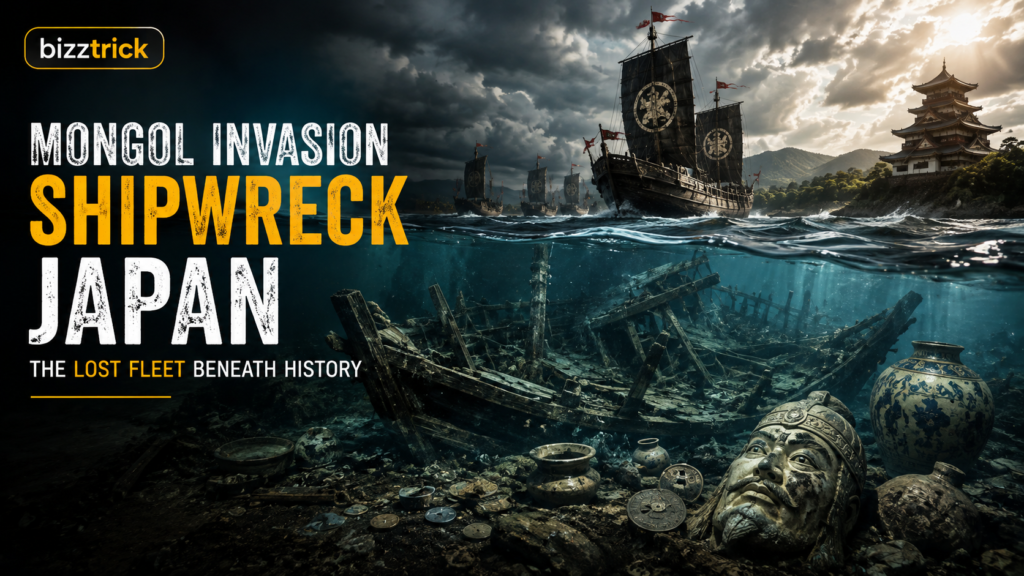

The Mongol invasion shipwreck Japan story is one of the most fascinating chapters in medieval maritime history. In the late 13th century, the Mongol Empire launched two major invasions of Japan, sending enormous fleets across the sea. The first campaign came in 1274, while the much larger second invasion followed in 1281.
Thousands of soldiers, sailors, horses, weapons, and supplies were transported across the water. Many of those ships never returned.
Centuries later, archaeologists began finding evidence of these lost fleets beneath the waters surrounding Japan. Ceramic objects, weapons, anchors, wooden remains, and other artifacts have helped researchers reconstruct what happened to the invasion fleets.
But what destroyed them? How were the wrecks discovered? And how much of the famous kamikaze, or “divine wind,” story is supported by historical evidence?
This article explores the history, archaeology, and significance of the Mongol invasion shipwrecks around Japan.
What Was the Mongol Invasion of Japan?
The Mongol invasions were military campaigns ordered by Kublai Khan, grandson of Genghis Khan and founder of China’s Yuan dynasty.
After establishing control over large areas of Asia, Kublai Khan sought to expand his influence toward Japan. Messages were sent to Japan demanding submission, but the Japanese government did not accept Mongol authority.
This eventually contributed to two invasion attempts.
The First Invasion in 1274
The first major invasion began in 1274.
The Yuan forces crossed from the Korean Peninsula toward Japan with a large fleet. They attacked areas of northern Kyushu, where Japanese warriors attempted to resist the invasion.
The invading army had unfamiliar weapons and tactics, including explosives and coordinated formations that differed from traditional Japanese warfare.
Despite initial successes, the Mongol forces withdrew.
The reasons for the withdrawal remain debated, but weather, logistical difficulties, resistance from Japanese forces, and strategic considerations all played roles.
The Second Mongol Invasion in 1281
The second invasion was considerably larger.
Kublai Khan prepared two major forces: one associated with Korea and another assembled in southern China. These forces eventually converged around Japan.
The invading fleet faced Japanese defensive preparations that had improved significantly since 1274.
Japan had constructed defensive walls along parts of the coastline, making it harder for Mongol forces to establish themselves on land.
The campaign became a prolonged struggle involving naval warfare, raids, and difficult logistical conditions.
Then disaster struck.
The Famous Storm
In 1281, a powerful storm hit the region.
Japanese tradition later remembered this event as a kamikaze, meaning “divine wind.” The storm was interpreted as divine protection that saved Japan from foreign conquest.
The typhoon caused enormous destruction to the invasion fleet.
Ships were smashed, driven onto shore, or sunk. Thousands of people are believed to have died.
However, it is important to avoid reducing the entire failure of the invasion to one storm.
The Mongol forces had already faced significant challenges, including Japanese resistance, supply problems, disease, prolonged campaigning, and difficulties operating far from their bases.
The storm was devastating, but it occurred within a much larger military and logistical story.
Where Are the Mongol Invasion Shipwrecks?
Archaeological research has identified remains associated with the 1281 invasion around Takashima Island in Nagasaki Prefecture, Japan.


The waters around Takashima have become especially important for researchers studying the invasion.
Underwater archaeological investigations have recovered numerous artifacts that provide clues about the fleet and its soldiers.
These discoveries are significant because written historical sources tell only part of the story. Archaeological evidence provides physical information about the ships themselves and the people who traveled aboard them.
What Has Been Found Underwater?
Researchers have recovered a variety of artifacts associated with the invasion.
Examples include:
- Ceramic objects
- Stone anchors
- Wooden ship components
- Weapons
- Military equipment
- Personal objects
- Cargo-related materials
- Pieces bearing inscriptions or identifying information
One particularly valuable category of evidence comes from objects that can be linked to the Yuan military system.
Archaeologists can examine the material, manufacturing techniques, inscriptions, and context of recovered artifacts to determine their likely origin and date.
The Significance of the Takashima Wreck
The Takashima discoveries are important because they offer a rare physical connection to one of medieval Asia’s most ambitious military campaigns.
Shipwreck archaeology can answer questions that written records cannot.
For example, researchers can investigate:
Ship Construction
Wooden remains can reveal how vessels were constructed and repaired.
Cargo
Artifacts can indicate what soldiers and sailors carried aboard the ships.
Military Organization
Weapons and marked objects can provide clues about the organization of the invading forces.
Trade and Cultural Connections
Ceramics and other manufactured goods can demonstrate connections between different regions of medieval East Asia.
This makes the wreck site valuable not only for Japanese history but also for understanding medieval Asian maritime networks.
Were the Ships Really Destroyed by a Typhoon?
The short answer is yes, a major storm played an important role, but the full historical picture is more complicated.
Historical accounts and archaeological evidence indicate that severe weather caused catastrophic losses.
However, the fleet was already vulnerable.
The invasion involved enormous numbers of people and ships operating across unfamiliar waters. Maintaining food, water, communication, equipment, and military coordination would have been extremely difficult.
Japanese forces also attacked the invaders and prevented them from easily securing a permanent foothold.
Therefore, the outcome should be understood as the result of military resistance, logistical challenges, environmental conditions, and the catastrophic storm rather than a single isolated event.
How Were the Shipwrecks Discovered?
The wrecks were not sitting untouched in an easily accessible location waiting to be found.
Underwater archaeology is challenging because currents, sediment, corrosion, biological activity, and storms can damage or bury artifacts.
Researchers have used diving, underwater surveys, archaeological excavation, mapping, and scientific analysis to investigate the remains.
The discovery process has gradually expanded historians’ understanding of the invasion.
Each artifact can provide another piece of evidence.
A fragment of wood may reveal ship construction. A ceramic object may help establish a date or origin. An inscription can potentially identify a military unit or production center.
Together, these discoveries create a much clearer picture.
Why the Mongol Shipwrecks Matter Today
The Mongol invasion shipwrecks are more than archaeological curiosities.
They demonstrate how historical events can survive through both written records and physical evidence.
They also illustrate the importance of maritime archaeology.
Much of human history happened at sea, but ships and their cargoes are often poorly represented in surviving historical documents.
A shipwreck can preserve an unusual snapshot of a specific moment.
In the case of the Mongol invasion, the underwater remains help researchers understand a campaign involving multiple cultures across East Asia.
Mongol Invasion Shipwreck Japan and the Kamikaze Legend
The story of the divine wind became deeply embedded in Japanese historical memory.
The term kamikaze became associated with the idea that supernatural forces had protected Japan from invasion.
Centuries later, the concept acquired a very different meaning during World War II, when “kamikaze” was used for Japanese military suicide attacks.
The medieval origin of the term is therefore important to Japanese cultural history.
However, modern historical research generally treats the 1281 storm within its environmental and military context rather than relying on supernatural explanations.
How Archaeology Changes Our Understanding of History
Historical narratives can sometimes become simplified over centuries.
A complicated military campaign may eventually be remembered as a single dramatic event.
Archaeology can challenge or refine these simplified versions.
The Mongol invasion shipwreck Japan discoveries demonstrate this process particularly well.
Instead of seeing the invasion simply as:
Mongols arrive → typhoon appears → Japan is saved
research provides a more complicated picture:
Mongol expansion → diplomatic conflict → invasion → Japanese resistance → logistical difficulties → prolonged naval campaign → severe storm → destruction of much of the fleet → Mongol withdrawal.
This broader interpretation gives readers a better understanding of how historical events actually unfold.
Frequently Asked Questions
Where were the Mongol invasion shipwrecks found?
Important archaeological remains connected with the 1281 invasion have been discovered in the waters around Takashima Island in Nagasaki Prefecture, Japan.
When did the Mongols invade Japan?
The Mongols attempted to invade Japan twice, in 1274 and 1281.
Who ordered the invasions?
The campaigns were launched under Kublai Khan, the Mongol ruler who also established the Yuan dynasty in China.
What destroyed the Mongol fleet?
A powerful storm in 1281 caused catastrophic losses, but Japanese resistance, logistical problems, and other difficulties also contributed to the failure of the invasion.
What is the kamikaze?
Kamikaze means “divine wind” and became associated with the storm that devastated the Mongol fleet in 1281.
Why are the shipwrecks important?
The wrecks provide physical archaeological evidence about the ships, soldiers, equipment, and material culture involved in the Mongol invasion.
Conclusion
The Mongol invasion shipwreck Japan story connects military history, archaeology, maritime technology, and Japanese cultural memory.
Kublai Khan’s attempts to conquer Japan were among the most ambitious military expeditions of medieval East Asia. The campaigns ultimately failed, and the catastrophic storm of 1281 played a major role in destroying the invading fleet.
Today, underwater archaeological discoveries around Takashima allow researchers to study physical evidence left behind by that extraordinary campaign. Shipwreck remains and recovered artifacts help transform a famous historical story into something tangible and scientifically investigable.
The most important lesson is that history is rarely as simple as legend suggests. The Mongol invasions were shaped by armies, ships, geography, logistics, weather, and human decisions—and the wrecks beneath Japan’s waters continue to preserve evidence of that remarkable encounter.